Author Archives: Jojo Karlin

Theorizing the Web 2016 Keynotes

Hey ITP,

The two keynote panels last night were very interesting in light of a number of our conversations about the possibilities and pitfalls of digital interactivity. The first panel (I think it’s called Cool Story) assembles several authors investigating representational possibilities of the internet and the use of the internet as content generation vs. regurgitation, also the difficulties of representing the internet in other media. The second panel (which starts at about 1hr 45 min) concerns the virality of evil on the internet and includes a presentation by ITP guest Jade Davis!

http://livestream.com/ttwconference/redstone/videos/119830402

I cannot recommend these panels enough!

Looking forward to conversation tomorrow.

-Jojo

Theorizing the Web, April 15&16, 2016

Hi friends!

I just remembered that I had really loved this conference last year, so I looked it up and wanted to see who would join me this year! I haven’t looked at the program yet (it just went up), but I figured I would let you all know sooner rather than later.

http://theorizingtheweb.tumblr.com/2016/program

ACHIM IS PRESENTING!

Now that I have seen that, we MUST go. 🙂

Always down to talk about what’s being talked about.

Jojo

Week 3/Feb 22: Let’s all get it done together

What does what OR How to get things done OR Let’s all get it done together

As Sara notes, 37 Signals, Getting Real (2009) definitely operates in the discourse of start-up. The text is snappy and feels like a pitch. It certainly presents an image and tone for agile development. While I appreciate many of the strategic impulses (not tying yourself down to padded check ins, establishing a minimum version for the sake of getting things done and testing them, finding a common “enemy”, and making things in a spirit of passion not tedium), I find the flashy presentation a bit off-putting. The fact that they preemptively address this potential resistance in the caveats does not, in my mind, let them off the hook.  I think Sara is onto something when she raises the concern about what people this approach may or may not encourage. The in-and-out quick model is easier to support if you are more accustomed to fallback securities — it’s easier to fail from a place of privilege. I would also argue that letting the users have a say is a way of outsourcing focus-groups. The way statistics and feedback are built into tools is a personal pet peeve. I once received a promotional email that claimed “people need to hear what YOU think”…on clothes?  The way the burden of feedback is put on the user strikes me as a devious redistribution of labor. I am now responsible for improving the tools I use? I can’t just pick out my tool at the store and consider the transaction finished? The app after app after app culture with constantly evolving features promotes this “user-oriented” development that seems to displace a lot of assessment, much the way we are the product in the free tools we use, we are the developers in the tools we comment on.

In academic development, I feel less cynical about the shared responsibility of use and revision. Without the paranoia about who is profiting from my feedback (because education as profit seems to me universally worthwhile), I am more forgiving in academic loops. Miriam Posner’s digest of digital tools, How did they make that?, is an amazing resource. The question of what to learn to make the things you want is persistent in Digital Humanities. When I revisited Bamboo DiRT, I revisited my sense of possibility and subsequent panic. I have poked around DiRT many times and I am continually overwhelmed by the breadth of tools and the degrees of use and disrepair of certain projects. DiRT is looking much better than when I first went on a year and a half ago, and the Assignment-in-a-box demonstrates a reciprocal action of use and evaluation that might be dubbed agile development in 37Signals. Are these built-in measures which invest students in the outcomes of their tools part of what we were talking about in terms of dynamic teaching last semester? Or is just a productive way to get conscientious feedback?

I find that these catalogs can be less terrifying when you start to meet people at events like Media Res (1&2), last week’s NYCDH events, and the GC Digital Research Bootcamp (everyone should apply for June). The community in NYC is remarkably open and encouraging, and the GC is such a vibrant part of that. I’m really looking forward to hearing former ITP students  Sarah Litvin, Christina Shane-Simpson, and Pamela Thielman talk about their Independent study projects!

Response and motivating thought:

I would like to sound a rallying call for us to work together!

I think the working group evenings (Mondays (2/29) and (3/21) 6:30-8:30, (4/18, 2-4pm NOTE TIME CHANGE)) are going to be a really excellent way for us to share our learning and build our projects. I also figured I would bookmark the remaining Digital Fellows Office Hours:

Mondays in the Digital Scholarship Lab, Room 7414

  • February 22 (2:00): Michelle & Patrick Sweeney
  • February 29 (5:30): Mary Catherine & Ian
  • March 7 (2:00): Michelle & Jen
  • March 14 (5:30): Ian & Jeremy
  • March 21 (2:00): Patrick Sweeney & Keith
  • March 28 (5:30): Mary Catherine & Jeremy
  • April 4 (2:00): Jen & Keith
  • April 11 (5:30): Hannah & Jeremy
  • April 18 (2:00): Patrick Sweeney & Ian
  • April 25: Spring Break – No office hours
  • May 2 (5:30): Hannah & Jeff
  • May 9 (2:00): Michelle & Keith
  • May 16 (5:30): Hannah & Jeff


Week 1: Chris Stein’s Contexts and Practicalities

A General Overview

I am most interested in the ways expediency might affect your goals in digital contexts when you pare your ideas down to fundamental components — do the conveniences of ready-made tools/code and the paralysis in the face of overwhelming quantities of learnable skills corrupt the integrity of the core ideas?

…but I will get back to these concerns in my provocation. First I’ll digest Chris Stein’s blog post a bit and attempt to point out some changes since its publication in 2011.

Chris Stein’s blog post offers a straightforward framework for building a digital project from inception to implementation. Addressing the best ways to simplify questions of use and users, Stein outlines guiding questions for prototyping:

  • why or what need
  • what you should build
  • who is going to use it
  • where you want to put it, and
  • when it will be ready.

Extracting a why (a clear question of what must be solved) from what should be built is a critical point.

In the who category, Stein draws our attention to distinguishing actors (roles of potential users) from personae (archetypical instances of actors). Defining concrete use cases is invaluable. Stein also talks about scale of usage: how many people one might reasonably accommodate with a project varies (Simple Web Site: 1,000’s, Dynamic Web Site: 100’s, Voice, Video Chat, Virtual Classroom, 10’s). There are so many resources available that clarifying these categories of who as early as possible helps narrow your searches.

In the where category, Stein considers where we deploy the tool (online, desktop, mobile, kiosk) and where our audience uses the tool.

When largely addresses practical projections of project completion. The adage “underpromise, overdeliver” will surely come up as we all begin to plan our projects.

Links

I often find links in context too difficult to track. So I pulled Stein’s list into this ref-list and found pdfs of the broken links and seminal articles.

Blog posts about designing your personal development plan:

Jason Santa Maria’s post about fitting design into workflow (July 26, 2010)

‘s Responsive web design (May 25, 2010) (he coined the term. RWD has changed dramatically since this article came out in 2010. Mashable called 2013 The Year of Responsive Web Design)

Alex Williams’s Risks/concessions of free software

Tom Kuhlmann approach to developing ELearning course

Older arguments about software development:

2005 post and comments about this instigating Nicholas Carr article

Fred Brooks’s 1986 article  “No Silver Bullet – Essence and Accidents of  Software Engineering” (FULL PDF) — Brooks talks about accidental and essential complexity (limit the first and acknowledge the second in developing software).

Jack Gordon and Ron Zemke trash the Waterfall Method, ADDIE or ISD Attack on ISD (Instructional Systems Design) (Training April 2000) (BROKEN LINK in Stein) — worthwhile read about how knowing the templated version of instructional systems design is not the most effective — a call for adaptability.

Klein’s Wikipedia glossary:

History Software Engineering 

Waterfall model

Scope Creep

Agile Software Development

User-centered Design — his example Nielsen Norman Group

Useful Image:
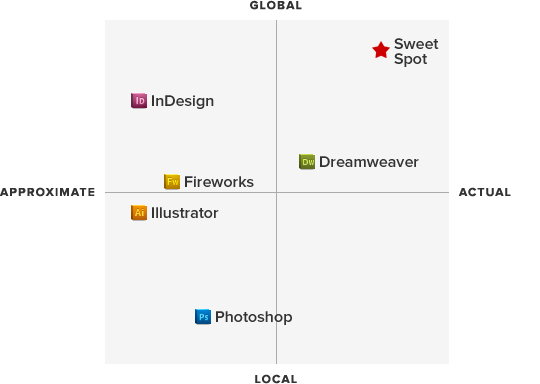
Caption from JSM’s post: “The x-axis shows how true-to-browser rendering ranges from approximate to actual, while the y-axis depicts the scope of centralized control over layout and type from local to global. The sweet spot lies somewhere at the intersection of browser-like behavior for—and widespread control over—type and layout elements, while providing a fertile environment for creative thinking.”

Jason Santa Maria discusses how designing for mobile devices presents a remarkable degree of complexity when it comes to aligning software and hardware for the widest range of users. The toolkit he describes has certainly evolved, but the chart helps describe what you should consider when picking your tools.


Provocation and Motivation

Ok ITP Core 2. I’m ready to discuss. I was sitting with a DH friend who does history of science and had this week’s reading open on my computer. He was distressed to see the apocryphal NASA pen story as a point of entry into the questions of project development. The fact that this example so bothered him struck me as a problem central to what we are doing. Is it okay to use a tool that exists (in this case a popular and memorable example) simply because it is convenient and seems to work? Do we have a responsibility to find better solutions? We are going to have to make many concessions in the interest of time, but does this sort of shorthand of example teach us to be hasty or is it okay because its application and qualifications point to our understanding that the situation is deeper than we have time to address? As students of the humanities and social sciences coming to software development, we cannot expect to teach ourselves the components learned by people who focus solely on software development. As we all conceptualize our work in terms of basic components and get down to our nuts and bolts, I hope we can be conscientious as well as efficient. Perhaps I am over-optimistic, but I look forward to our collective attempts.

NYCDH Week of DH free workshops!

Hi ITP Core 2,

I tried posting this to the Forum, but it wouldn’t let me submit, hence the blog post. I just wanted to let you know about the upcoming workshops through NYCDH! It may have gone out over GC Digital Initiatives or another listserv, but I’m all for redundancy.

So! Check out the awesome events available next week!
http://dhweek.nycdh.org/

At the very least, I hope some of you will come to the kickoff lightning talks at the NYCDH Week Kickoff on Tuesday, Feb 9th at 1:30 pm at Fordham’s Lincoln Center campus! Seeing the sorts of DH work people are doing in the city could be really helpful for brainstorming ITP projects, and then perhaps you’d get a better sense of tools you might want to explore in the workshops they have available. I am hoping to catch a couple workshops, so let me know if you want to go!

-Jojo

#ITPCore2 @jojokarlin


IMG_1816After testing the waters in the Grad Center’s Digital Humanities program last year, I have taken the plunge into the English PhD. I am particularly interested in the ways periods of rapid technological transformation affect memory (cultural and personal). Many tools that seem to displace the burden of memory or alter the responsibility of cultural preservation, shift our sense of ourselves, and I am interested in developing work that tests or represents the ways we share memory across time and space and across the span of technological advances and obsolescence.

I look forward to another provocative and motivational semester with the ITP team!

-Jojo
